
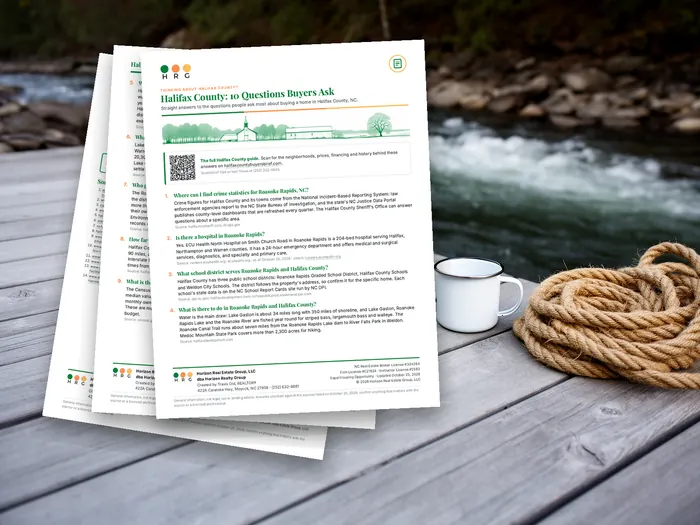
Halifax County Contracts: The Cost of Walking Away


In this post
Every North Carolina purchase contract contains an attorney’s fee clause, and for most of the state’s history it was unclear how much weight that clause carried in a real estate dispute. The North Carolina Supreme Court answered the question in June 2022. In Reynolds-Douglass v. Terhark, the Court held that an Offer to Purchase and Contract is an evidence of indebtedness under N.C.G.S. § 6-21.2, which makes the prevailing party’s attorney’s fee provision enforceable in a suit to recover an earnest money deposit.
What happened in Reynolds-Douglass v. Terhark?
The dispute behind the 2022 ruling began as a $250,000 home sale in Wake County. The buyer signed the standard Offer to Purchase and Contract with a $2,000 due diligence fee and a $2,500 additional earnest money deposit, then tried to renegotiate the price down by $5,500 three days later. When the seller refused, the buyer never paid either fee and the contract collapsed. The seller first won the due diligence fee in small claims court, then amended the case to recover the earnest money deposit and attorney’s fees. The final judgment was $18,343.92, of which $13,067.70 was attorney’s fees, and the buyer appealed to the state Supreme Court.
Why did the court call the contract an evidence of indebtedness?
North Carolina follows the American rule: each side pays its own attorney’s fees unless a statute authorizes an award. N.C.G.S. § 6-21.2 is one of those statutes, covering notes, conditional sale contracts, and other evidence of indebtedness. The buyer in this case argued that a home purchase contract was not such an instrument. The Court rejected that reading. An Offer to Purchase and Contract is a written instrument, signed by the parties, that on its face evidences a legally enforceable obligation to pay money, which is exactly the definition the Court adopted in Stillwell Enterprises v. Interstate Equipment in 1980. The Court also held that attorney’s fees for defending the judgment on appeal are recoverable.
What did the dissent argue?
The dissent saw the majority’s reading as a break from the state’s long-standing policy that attorney’s fees are not recoverable unless a statute expressly allows them. The dissenting justices would have capped fees at 15 percent of the outstanding balance under the statute’s formula, which here would produce $375 on the $2,500 earnest money deposit rather than the $13,067.70 awarded. They also read the statute as limited to commercial transactions. The majority held that the statute’s plain language does not carry that limit and that the contract’s own fee clause governed.
How does this play out in Halifax County?
Halifax County is the I-95 corridor county, and its market runs on two engines: Roanoke Rapids, the commercial hub on Roanoke Rapids Lake, and the historic town of Halifax, where the 1776 Halifax Resolves made the first official call for independence. Buyers here include out-of-area commuters and people passing through on the interstate, which means a meaningful share of contracts are signed by buyers who are not local and may not fully understand the document. Large rural and agricultural tracts around the lake make title research and tax status verification especially important on acreage deals.
Where do Halifax County closings actually happen?
Halifax County has a closing requirement that stands out even by North Carolina standards. Since January 1, 2016, the Register of Deeds will not accept a deed unless the Tax Collector certifies that no delinquent ad valorem taxes are a lien on the property. That makes tax-lien clearance a mandatory step in every Halifax closing. The county’s real estate records reach back to 1732, with online indexes and images from 1976 to the present, and its qPublic portal publishes tax parcel and assessment data. Tax foreclosure sales are held at the courthouse, sold as is with a 10-day upset bid period.
A local example: Roanoke Rapids
A buyer signs a contract on a lakeside lot near Roanoke Rapids, pays a $1,500 due diligence fee and a $2,500 earnest money deposit, then has second thoughts during diligence about the commute on I-95. The buyer can walk during the diligence period and get the earnest money back, losing only the due diligence fee. If the buyer lets the period expire and then walks, the seller keeps the deposit as liquidated damages, and under the 2022 Supreme Court ruling the buyer can also owe reasonable attorney’s fees if the seller has to sue to collect it. And if the seller’s taxes were not current, the deed could not even be recorded until they were cleared, another reason the diligence period is where those questions belong.
The bottom line
The lesson for buyers in this county is the same as the lesson from the 2022 ruling: the contract is enforceable, and the fees are real. Use the due diligence period for what it is for, and do not let it lapse with questions still unanswered. Once the period is gone, the earnest money is at risk, and so is the other side’s attorney’s fee exposure.
This article is educational, not legal advice. If a contract question comes up, talk to a North Carolina real estate attorney, and have the actual contract reviewed before you sign it.
Keep reading
Weldon's Fall Line: Canal, Rail, and the Houses Left Behind
Weldon grew up around a granite ledge, then a canal, then a railroad. What those decades left behind in the housing stock, block by block, for buyers.

Five Drives That Decide Where You Live in Halifax County
Five drives that decide where you live in Halifax County: I-95 south to Rocky Mount and north to Virginia, US-301 through the towns, and the lake road.

Halifax County Property Taxes: Four Layers, One Bill
Halifax County property taxes for buyers: FY 2025-26 rates town by town, school supplemental levies, the four-year revaluation cycle, and escrow.